Home
Most people are scared of sharks because of horror stories people have heard or have experienced. Less than 100 people are killed by sharks a year, majority being killed by a great white shark. Some of those fear turns into hate for these beautiful creatures when they are spotted. Every year, over 100,000,000 (100 million!) sharks are killed, from people hunting them for their fins and then just leaving the shark to just die, climate change, habitat loss, and bycatching, which is when sharks get caught in fishing nets or other fishing equipment and end up getting stuck and will die. Currently, there are over 1,000 different types of sharks that are endangered, and it is only a matter of time before they will disappear altogether.
This site is designed to talk about only a few species of sharks, some endangered and some that are considered vulnerable. The more information that you know about sharks, the less scary and intimidating they are. Some species are gentle giants, like the whale shark, where as other species, like the great white shark, is known to kill more people than other sharks. Last year, in 2023, there were about 90 people that were bitten by sharks, and only 10 of those attacks were fatal. A main reason why sharks bite people is because they are confused or curious. reason why they may bite is because someone is intruding on their home, or accidentally mistake us for their food, like seals. Sharks are normally the most active during dusk, so it best to avoid being in the water during dusk, dawn, or night since they are not easy to be seen during those times.
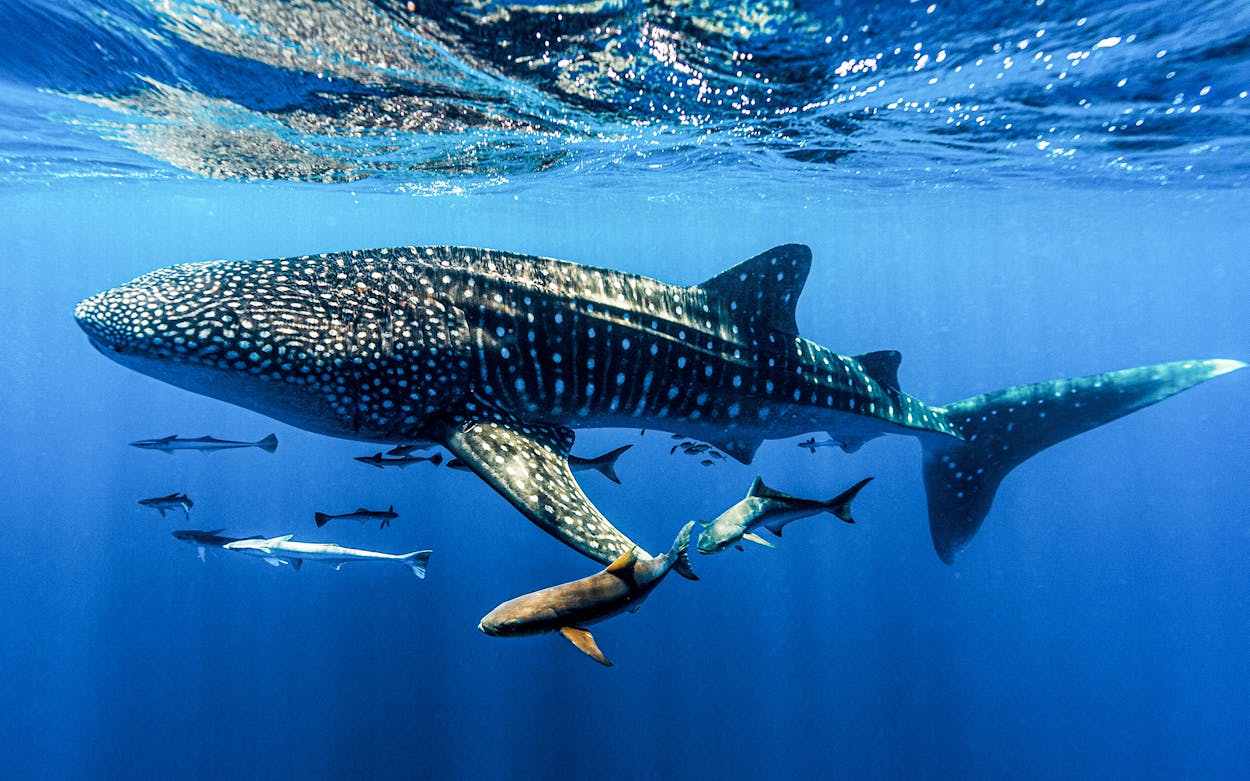
Image courtesy of TexasMonthly
Whale Shark
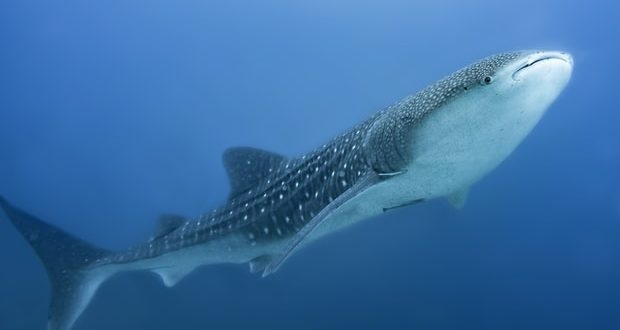
Whale sharks are known for their gentle nature and white spots, stripes, and white underbelly. They are filter-feeders that prefer waters filled with plankton, which regulate the number of plankton in the ocean. They will also eat fish since they always swim with their mouths wide open. Whale sharks can live anywhere from 80 to 130 years. They are the largest fish and largest species of shark, the largest recorded whale shark being 61.7 feet long. The average height of whale sharks ranges from 18 feet to 40 feet. They are not aggressive towards us and do not threaten us. When swimming with these creatures, there is no need to fear them since they have no intention of eating you. They have about 3,000 teeth at a time, but do not use them. They live in all warm and temperate oceans except for the Mediterranean.
Currently, whale sharks are considered endangered. Whale sharks are often killed because of bycatching and boats. They also get trapped in fishing gear and their habitat being destroyed causes them to be killed. Fisheries, which are places in which humans catch, breed, raise, and market fish, sharks, and other ocean dwellers for great profit, also have a great impact on the population of whale sharks. In addition, whale sharks are considered a delicacy in Asia. Less than 10% of whale sharks born survive to adulthood because adolescent whale sharks are sought not only by humans, but by other species of sharks. Climate change, plastic pollution, and humans pose a great danger to these gentle creatures. Each year, anywhere from 10 to over 8,000 whale sharks are killed every year, contributing to the 100 million of sharks that are killed each year.
Image courtesy of BioExpedition
Blue Shark
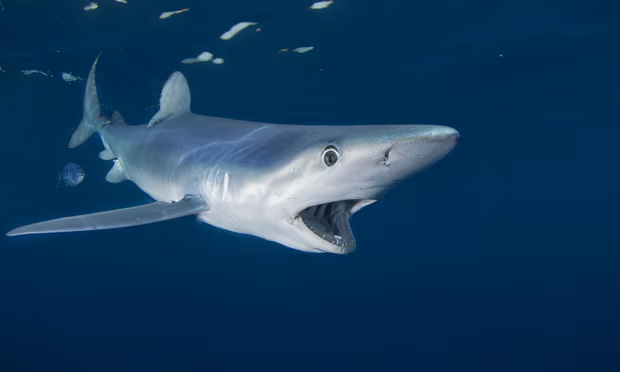
Blue sharks inhabit the deep waters of the warm and temperate oceans. They are known to be very fast swimmers, reaching speeds up to 43 miles per hour. Blue sharks feed on small fish and squid and can live up to 20 years. They can range from 6 feet up to almost 11 feet long, the longest blue shark reaching up to 20 feet. An interesting fact about blue sharks is that they normally range from 60 pounds up to 450 pounds, but the heaviest blue shark ever recorded was 862 pounds. Blue sharks live off all the coasts of every continent, except Antarctica. Blue sharks are not known to bite or attack humans, which up until now, there have only been about 13 biting incidents.
Blue sharks were considered not threatened, but until recently they are now considered near threatened. Young blue sharks are often eaten by larger sharks, like the great white shark and tiger shark, and even orcas. Sea lions and seals have been seen to feed on blue sharks as well. Blue shark meat is not widely sought out for, but the skin is used for leather, the fins for shark-fin soup and the liver for oil, like what most sharks are used for when killed. Aquariums cannot keep blue sharks because they tend to not do well in captivity, with most not living past three months in captivity and the longest being about a year old.
Image courtesy of The Guardian
Thresher
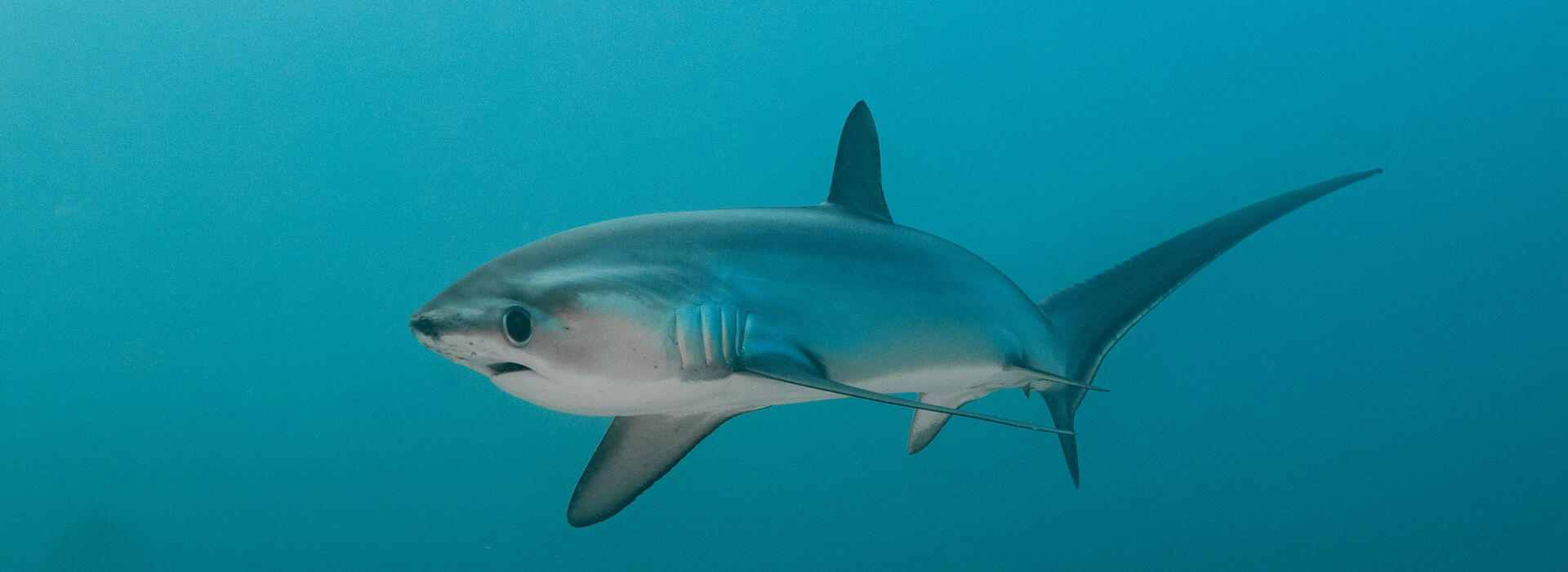
Thresher sharks are incredibly shy, but can be very friendly. The thresher shark is known for its large eyes and long tail that can be almost as long as the shark itself. Thresher sharks can live anywhere from 19 to 50 years. There are three different types of thresher sharks: common thresher shark, pelagic thresher shark, and bigeye threshers. Common threshers are the largest out of the three types, growing up to 19 feet long. Pelagic threshers can only reach up to 3 feet. Bigeye threshers can grow up to 13 feet. Common and bigeye threshers can be found in all of the oceans, while pelagic threshers are only found in the Indian and Pacific Oceans. Threshers main defense is their tail, which they can essentially whip around, creating shock waves to immobilize schools of fish. The thresher sharks are one of the fastest creatures that reside in the ocean, reaching speeds up to 22 miles per hour. A cool fact about thresher sharks are that they have an adaptation called regional endothermy, which allows them to maintain their body temperature to be that of the surrounding water so they can reach deeper depths up to almost 5,000 feet deep.
Currently, threshers are considered endangered. The amount of threshers the last few years have been decreasing greatly, mostly due to finning and harvesting them for their fins and skin. They are not dangerous to humans, but some people see them as threats, choosing to kill them. There is a chance that a thresher shark will attack a boat, but only if the boat is invading their home. Their meat and fins from a thresher shark have good commercial value. Their hides are used for leather and their liver oil is used for vitamins. Fisherman from Japan, Spain, Brazil, the USA, along with a few other places, normally catch these sharks.
Image courtesy of Original Diving
Contact