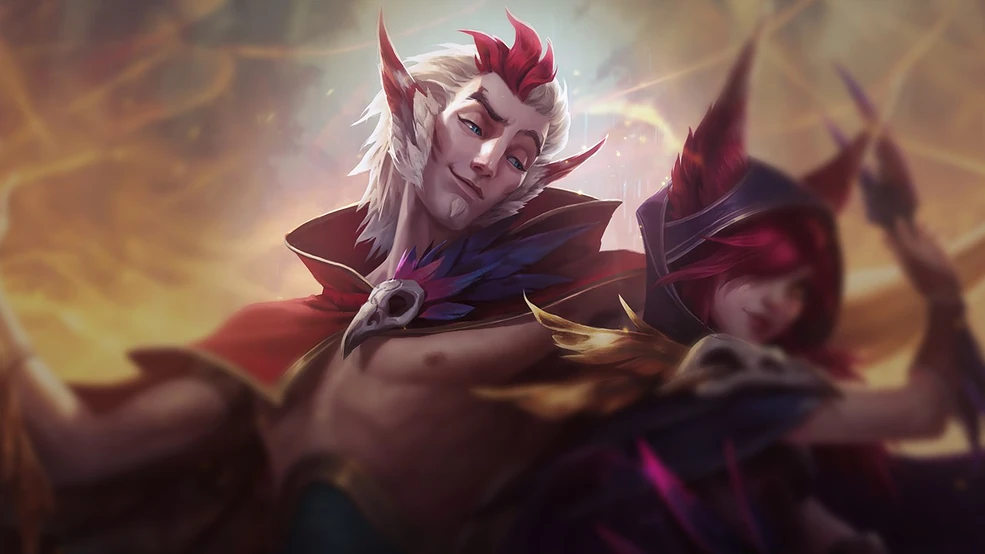
The Lhotlan vastaya once lived on the ancient, mystical borders of Ionia’s deep forests, on the eastern island of Qaelin. It was a place where magic was breathed like air, and time had little meaning. To these chimeric creatures, the lands of mortals were an unforgiving desert, virtually devoid of magic—and over the centuries, that desert only grew, encroaching on the vastaya’s territories. Rakan was born into a tribe in decline, yet he never gave up hope.
Like his brethren, Rakan watched as human settlements continued to expand, damming the flow of Ionia’s wild, chaotic magic for their own safety. Many tribes sent emissaries to negotiate with them, securing treaties to protect the mystical energy the vastaya needed to thrive. Yet over and over again, these promises were broken. Disillusioned, most vastaya became increasingly isolationist as they clung to their remaining lands. But young Rakan advocated a different path. The battle-dancer believed that mortals could be convinced to let wild magic run free if they could only appreciate its beauty, and he boasted that he was the one to make them see it. For this, he was labeled mu’takl—distrusted as a human sympathizer, and collaborator.
Rakan left the Lhotlan tribe, determined to spread the song of his people across Ionia. He was an entertaining rogue, a welcome performer at any tavern or village carnival, but over the years he realized that was all he was to mortals—no matter how many dances and songs he performed, no matter how much he enthralled the crowds, he merely provided diversion to drunken revelers. Rakan grew restless, finding himself without purpose... until he had a chance encounter with Xayah, a fellow Lhotlan, at the harvest festival in Vlonqo.
Seeing her in the crowd, Rakan sang one of his old songs, entrancing the entire town with his gleaming plumage. Though countless human and vastayan women had fallen for him in the past, this violet raven seemed immune to his charms, though not uninterested. How could she see him and yet choose not to follow him? It was a puzzle with no easy answer.
Intrigued, the battle-dancer approached Xayah and asked after the welfare of their tribe. When she told him that the Lhotlan had lost the last of their lands, Rakan howled with rage. This finally seemed to impress Xayah, and she assured him that there was still hope: she was part of something greater, a rebellion of sorts, to take back what the vastaya had lost. Not just for the Lhotlan, but for all tribes. Rakan was thunderstruck. Here was a chance for him to redeem his people, a cause he was willing to die for. He implored Xayah to let him accompany her, and she agreed—as long as he carried his weight.
And, as Xayah would soon learn, Rakan’s dances were as impressive in battle as they were on stage. He called himself the greatest battle-dancer in Lhotlan history, a boast that none could refute. His grand entrances and dazzling acrobatics distracted and befuddled enemies, before Xayah felled them with her razor-sharp quills. In any dangerous situation, they fought together with uncanny harmony. During their travels, Rakan became fascinated by how Xayah interacted with the world. She seemed always prepared, aloof, and focused... whereas he was absent-minded, affable, and lacking seriousness. Although Rakan would often forget her carefully laid plans, he made up for it with his ability to read the emotions of others, using charisma and insight to persuade them. The two vastaya were so different, and yet they achieved great feats, each one’s strengths complementing the other’s weaknesses.
Soon enough, Rakan couldn’t imagine life without Xayah, and it was clear that she felt the same for him. The pair pledged themselves to each other in the midst of a raucous tavern brawl. Yet they did not see eye to eye in all things. Where she viewed the world as black and white, with mortals always the enemy, he had more compassion, and believed some of them were redeemable. Despite this difference, Rakan was certain that his and Xayah’s love for each other would bear them through the storms that lay ahead. Through Xayah, Rakan has found purpose. Inspired by his partner’s singular drive, Rakan has made her crusade his own, and together they will fight to reclaim the First Lands for the vastaya.
Xayah, The Rebel
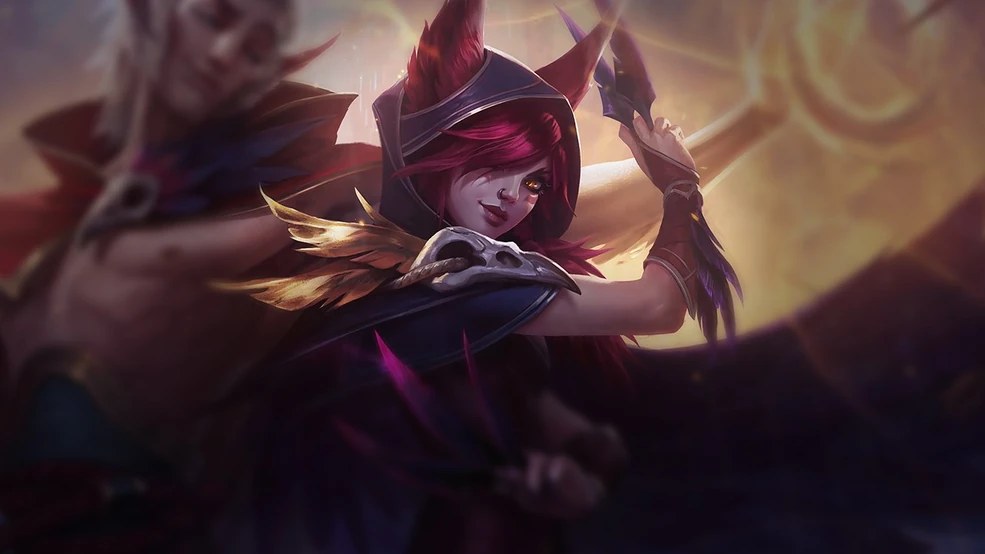
As a child of the Lhotlan tribe, Xayah loved listening to her father sing folk-hymns about ancient vastayan heroes. The haunting melodies transported her to a long-forgotten time, when magic danced freely through the island of Qaelin, imbuing the Lhotlan with immense power. Yet with each new generation, humans encroached farther into all the vastaya’s ancestral tribelands, disrupting their raw essence. The tribes began to fade, losing vitality as they were gradually cut off from the spirit of the First Lands, and were forced to negotiate with their mortal rivals.
Xayah watched in frustration as, time and again, her tribe’s juloah ambassadors made treaties with mortals that were swiftly broken. Most disturbingly, humans had discovered the secrets of towering constructs known as quinlons, and were using them to inhibit Ionia’s natural magic in order to protect their expanding settlements. Even though Xayah and others like her urged their people to fight back, the Lhotlan instead withdrew into themselves, shunning the mortal world as they clung to what little they had left. Yet this would not protect them, and they were eventually driven from their homes.
The Lhotlan became rootless nomads. Xayah became a freedom fighter. And she was not alone. Vastayan rebellions were growing across Ionia, seeking retribution against mortals. The time for negotiation was over. Xayah was determined to use her lethal quills in battle, to release the land’s wild magic. Flitting in and out of the most fortified strongholds and leaving a trail of bodies in her wake, she earned the sobriquet “the Violet Raven”. Her dedication to the cause was unmatched, as she focused only on the next mission, and the next step toward freedom for her kind. Though she cherished her rebel allies, she usually acted alone, believing she could do the job better than any other.
But then she met another vastaya who would change her life forever. After she entered the remote mountain town of Vlonqo in search of a stolen artifact, she was struck by the sight of a braying crowd of humans. Onstage before them stood a preening, flamboyant performer, who sang old vastayan songs for his captivated audience. As he finished his show with a dazzling array of cheap tricks, the crowd erupted and chanted his name: Rakan! Rakan! Rakan! He took a theatrical bow. Xayah dismissed him as a buffoon. A fellow Lhotlan he might be, but this Rakan seemed like nothing more than a foolish mu’takl.
Xayah willed herself to ignore him, and completed her mission... which she couldn’t deny had become far easier thanks to Rakan distracting the locals. Before Xayah could flee into the wilderness, Rakan accosted her. After making a series of failed attempts to charm her with flattery, the brash vastaya asked for news of the Lhotlan tribe. When she told him they had lost their lands, his plumage darkened, and she was surprised at the depth of his rage. Perhaps there was more to Rakan than she’d thought. When she told him of her true cause, he begged to join her. Seeing potential in his ability to create diversions, if nothing else, Xayah agreed.
When they began their travels, she saw Rakan as a useful—but annoying—asset. The showboating battle-dancer would leap and pirouette through enemies with ease, distracting them before Xayah struck them down. Indeed, this fighting style almost compensated for his irritating inability to remember Xayah’s meticulous plans. Rakan helped Xayah in other ways as well. While she was blunt and abrasive, he was insightful and charismatic, able to use charm and persuasion where she would have resorted to violence. She was impressed by his uncanny ability to assess people’s emotions and trustworthiness. She sometimes questioned Rakan’s compassion for mortals, but never doubted his devotion to the rebel cause.
Eventually, Xayah realized her feelings for Rakan were changing. There was a lightness to him and his free-spirited ways that she found aggravatingly alluring. Over time, she grew to welcome his company, and—though she was initially loath to admit it—the world didn’t feel so broken and lonely. They became inseparable. In all the years since, the two of them have become formidable champions of the vastaya, and word of their deeds is spreading. In the wake of the Noxian invasion, Ionians are undeniably more aggressive and dangerous—especially the peoples of Navori, and the hated “Order of Shadow”. Even so, this has enabled Xayah and Rakan to rally countless more vastaya to their side, and their dream of rebellion is coming to fruition. Together, they will fight to reclaim the First Lands, so that the tribes may thrive once again.